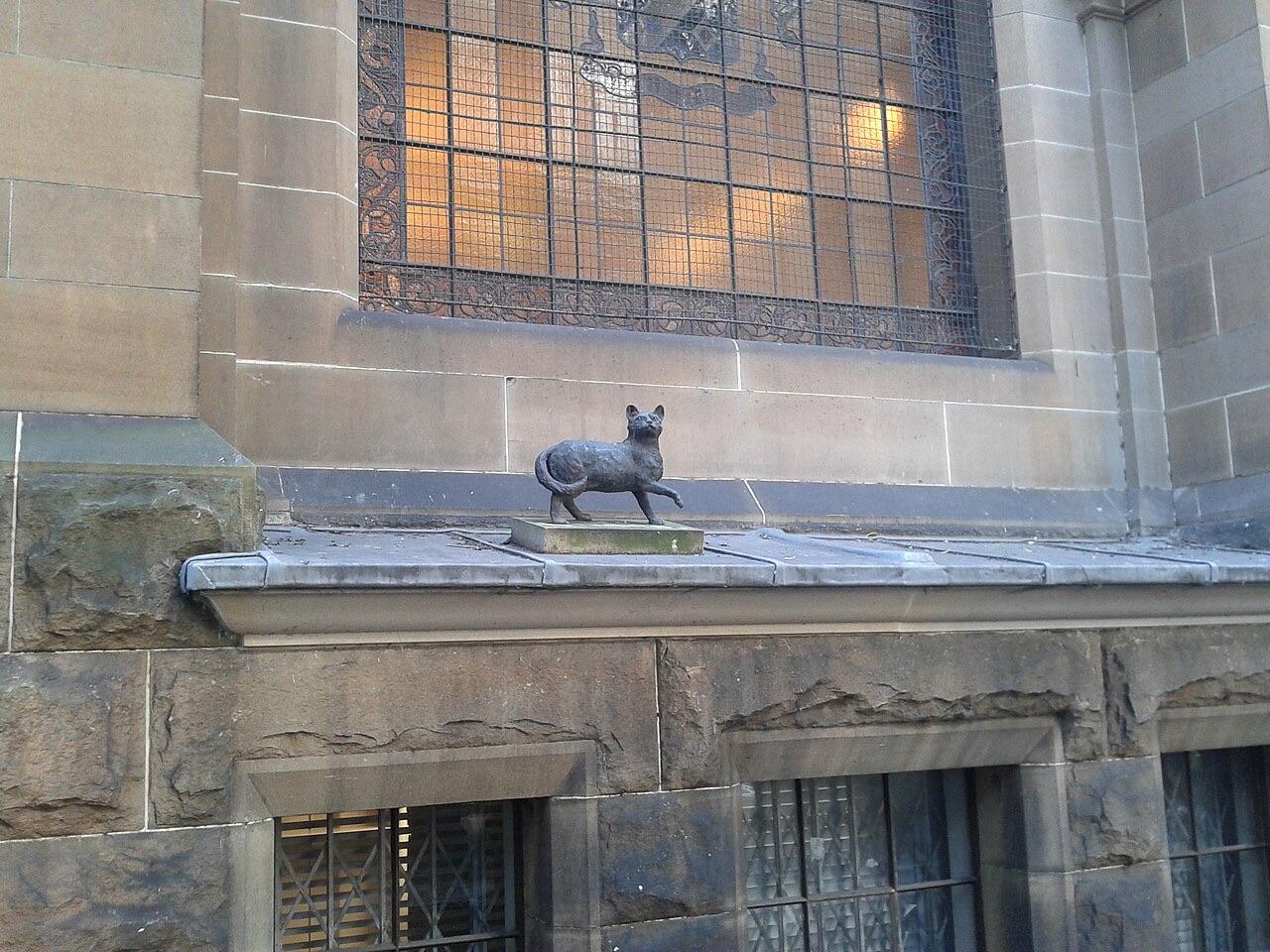
Statue de Trim, Mitchell Library, Sydney. Wikimedia Commons (domaine public).
Né en mer
Trim naît en 1799 à bord du Reliance, pendant la traversée du cap de Bonne-Espérance à Port Jackson. Noir, les pattes et une étoile sur la poitrine blanches, il doit son nom au fidèle caporal Trim du Tristram Shandy de Laurence Sterne.
Tombé à l'eau un jour, il remonte à bord en s'agrippant à un cordage qu'on lui lance : l'équipage l'adopte, et il apprend vite à s'y retrouver dans le gréement comme sur la table des officiers.
Autour de l'Australie
Trim accompagne Flinders sur l'Investigator tout autour du continent, survit au naufrage du Porpoise sur Wreck Reef, puis embarque sur la Cumberland. Il partage la captivité de son maître à l'île de France, où il disparaît en 1804 ; Flinders soupçonna qu'il avait fini dans une marmite.
Une mémoire de bronze
Pendant sa captivité, Flinders écrit un « hommage biographique » à la mémoire de Trim, publié bien plus tard. Le chat a aujourd'hui ses statues : sur le rebord d'une fenêtre de la Mitchell Library à Sydney, à Port Lincoln, à Donington, et aux pieds de son maître devant la gare d'Euston, à Londres.
La rencontre d'Encounter Bay
8 et 9 avril 1802
Une voile à l'horizon
Le 8 avril 1802, un « rocher blanc » signalé du haut du mât se révèle être un navire. Flinders fait le branle-bas de combat : la France et l'Angleterre sont en guerre. Le bâtiment hisse pavillon français, puis un pavillon anglais à l'avant, tandis que l'Investigator arbore un pavillon blanc. C'est le Géographe de Nicolas Baudin.
Deux commandants dans une chambre
Flinders monte à bord du navire français avec le naturaliste Robert Brown. Baudin lui raconte ses découvertes sur la Terre de Van Diemen et critique une carte anglaise du détroit de Bass, publiée en 1800 — sans savoir que son auteur est assis en face de lui. Les deux hommes se revoient le lendemain matin, puis chacun reprend sa route.
« Le capitaine Baudin me fit part volontiers de ses découvertes sur la Terre de Van Diemen, ainsi que de ses critiques d'une carte anglaise du détroit de Bass publiée en 1800. Il trouvait beaucoup à redire à la côte nord du détroit, mais louait la forme donnée à la côte sud et aux îles voisines. »
Le lendemain, Flinders donne au lieu le nom d'Encounter Bay, « en mémoire de notre rencontre en ce lieu ».
Sept cents milles en canot
Wreck Reef, août-octobre 1803
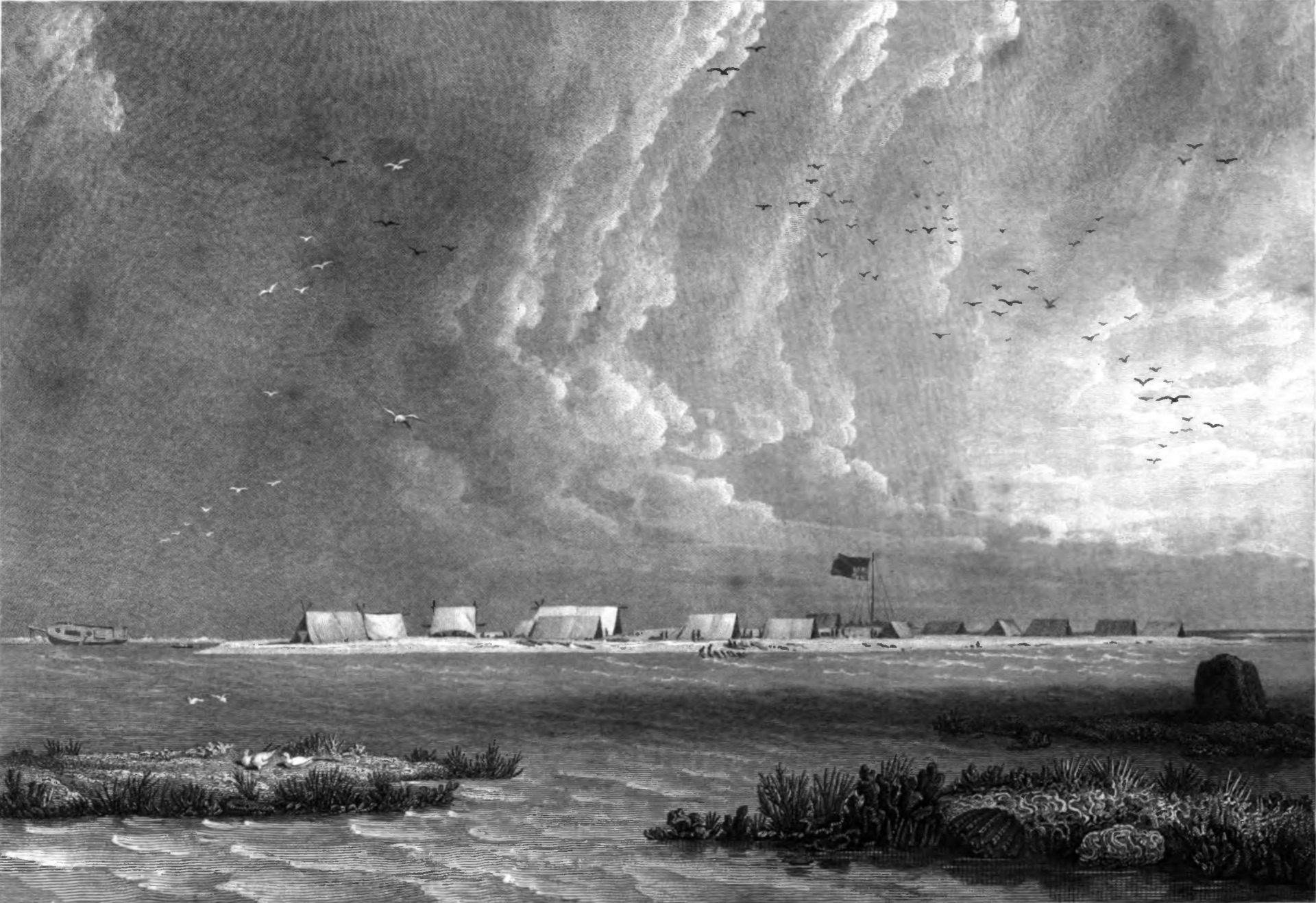
View of Wreck-Reef Bank, taken at low water, d'après William Westall, gravé par John Pye pour l'atlas de 1814. Wikimedia Commons (domaine public).
Le naufrage
Dans la nuit du 17 août 1803, le Porpoise, où Flinders a pris passage pour l'Angleterre, et le Cato qui le suit se brisent sur un récif de la mer de Corail. Le troisième navire du convoi, le Bridgewater, passe au large et poursuit sa route sans leur porter secours.
Le camp du banc de sable
Les naufragés, près de quatre-vingt-dix hommes, se réfugient sur un banc de sable voisin, où ils sauvent vivres, eau et instruments. Le 26 août, Flinders part avec treize hommes dans le grand canot du Porpoise, qu'il baptise Hope, pour chercher du secours à Port Jackson, à plus de 700 milles.
Le retour
Il atteint Sydney le 8 septembre, et revient le 7 octobre avec trois navires, le Rolla, le Francis et la petite Cumberland. Sur le banc, le pavillon flotte toujours : tous les naufragés qui y attendaient sont sauvés. Flinders repart aussitôt pour l'Angleterre… sur la Cumberland.
Une tombe sous la gare d'Euston
Londres, 1814-2024
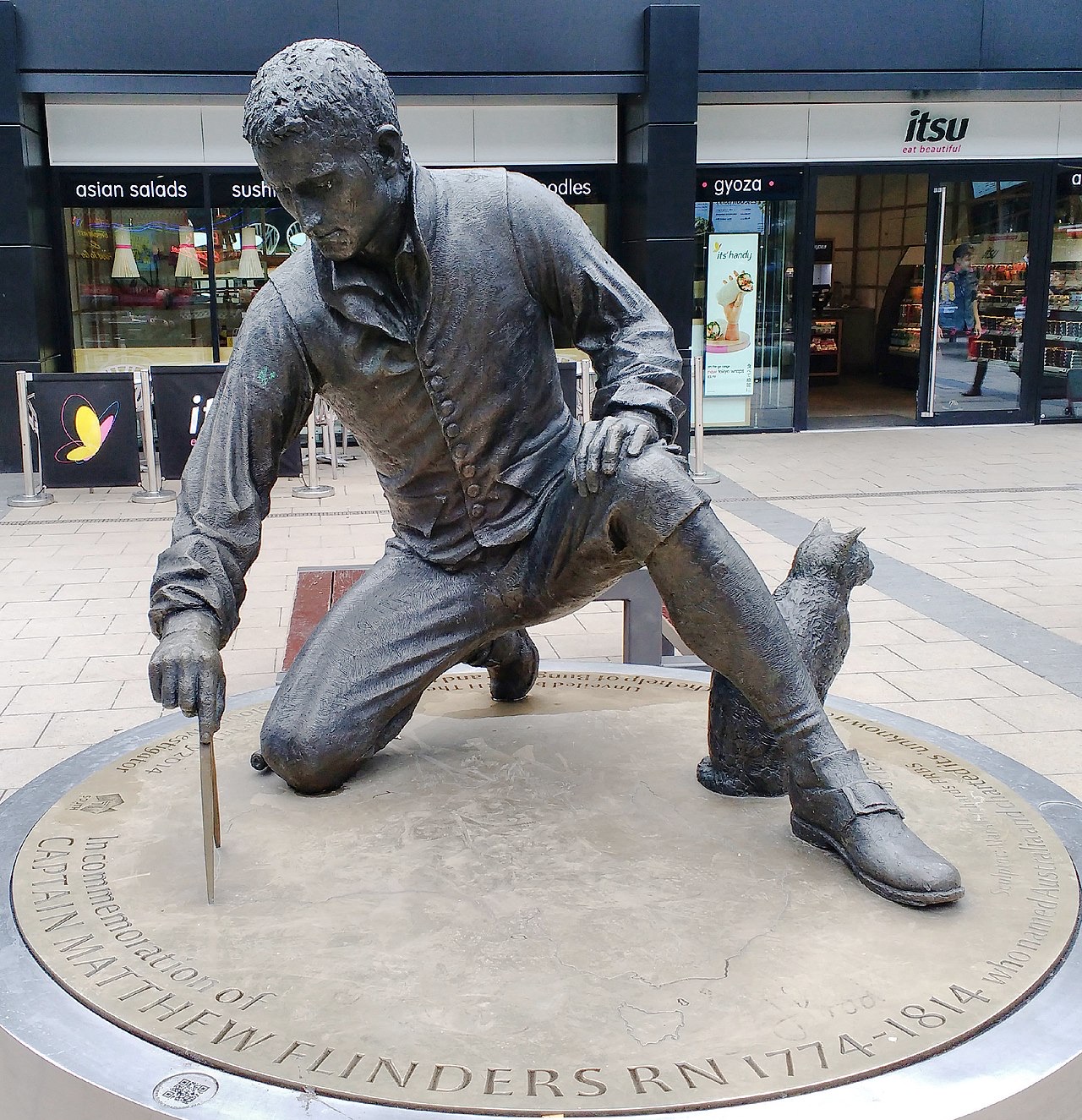
Statue de Matthew Flinders et de Trim par Mark Richards (2014), gare d'Euston, Londres. Photo AndyScott, Wikimedia Commons, CC BY-SA 4.0.
Un tombeau perdu
Flinders meurt à Londres le 19 juillet 1814, au lendemain de la parution de son Voyage to Terra Australis. Il est inhumé au cimetière de St James's, sur Hampstead Road. Au XIXe siècle, l'extension de la gare d'Euston bouleverse le cimetière, et l'emplacement de sa tombe se perd.
2019 : la plaque de plomb
En janvier 2019, les archéologues qui fouillent l'ancien cimetière avant les travaux de la ligne à grande vitesse HS2 mettent au jour un cercueil portant une plaque de plomb au nom de Matthew Flinders. Parmi quelque 40 000 sépultures, son identification tient à cette seule plaque, restée lisible.
Le retour à Donington
Le 13 juillet 2024, ses restes sont inhumés à nouveau dans l'église St Mary and the Holy Rood de Donington, son village natal du Lincolnshire, deux cent dix ans après sa mort.
Anecdotes
Four stories from Matthew Flinders’s voyages.
Trim, the ship's cat
A companion on every campaign · 1799–1804
Statue of Trim, Mitchell Library, Sydney. Wikimedia Commons (public domain).
Born at sea
Trim was born in 1799 aboard the Reliance, on the passage from the Cape of Good Hope to Port Jackson. Black, with white paws and a white star on his breast, he was named after the faithful Corporal Trim of Laurence Sterne's Tristram Shandy.
Falling overboard one day, he climbed back up a rope thrown to him: the crew adopted him, and he soon knew his way about the rigging as well as the officers' table.
Round Australia
Trim went with Flinders in the Investigator right round the continent, survived the wreck of the Porpoise on Wreck Reef, then sailed in the Cumberland. He shared his master's captivity on the Isle de France, where he disappeared in 1804; Flinders suspected he had ended up in a cooking pot.
A memory in bronze
During his captivity Flinders wrote a "biographical tribute" to Trim's memory, published long afterwards. The cat now has his statues: on a window ledge of the Mitchell Library in Sydney, at Port Lincoln, at Donington, and at his master's feet outside Euston station in London.
The meeting in Encounter Bay
8 and 9 April 1802
A sail on the horizon
On 8 April 1802 a "white rock" reported from aloft turned out to be a ship. Flinders cleared for action: France and England were at war. The stranger showed a French ensign, then an English jack forward, while the Investigator flew a white flag. She was Nicolas Baudin's Géographe.
Two commanders in a cabin
Flinders went aboard the French ship with the naturalist Robert Brown. Baudin told him of his discoveries in Van Diemen's Land and criticised an English chart of Bass Strait published in 1800 — unaware that its author was sitting opposite him. The two men met again the next morning, then each went his way.
« Captain Baudin was communicative of his discoveries about Van Diemen's land; as also of his criticisms upon an English chart of Bass Strait published in 1800. He found great fault with the north side of the strait, but commended the form given to the south side and to the islands near it. »
The next day Flinders named the place Encounter Bay, "in consequence of our meeting here".
Seven hundred miles in an open boat
Wreck Reef, August–October 1803
View of Wreck-Reef Bank, taken at low water, after William Westall, engraved by John Pye for the 1814 atlas. Wikimedia Commons (public domain).
The wreck
On the night of 17 August 1803 the Porpoise, in which Flinders had taken passage for England, and the Cato following her struck a reef in the Coral Sea. The third ship of the convoy, the Bridgewater, stood off and sailed on without giving help.
The camp on the sandbank
The castaways, nearly ninety men, took refuge on a nearby sandbank, where they saved provisions, water and instruments. On 26 August Flinders set out with thirteen men in the Porpoise's cutter, which he named the Hope, to seek help at Port Jackson, more than 700 miles away.
The return
He reached Sydney on 8 September, and was back on 7 October with three ships, the Rolla, the Francis and the little Cumberland. On the bank the ensign was still flying: all the castaways waiting there were saved. Flinders sailed at once for England… in the Cumberland.
A grave beneath Euston station
London, 1814–2024
Statue of Matthew Flinders and Trim by Mark Richards (2014), Euston station, London. Photo AndyScott, Wikimedia Commons, CC BY-SA 4.0.
A lost grave
Flinders died in London on 19 July 1814, the day after A Voyage to Terra Australis was published. He was buried in St James's burial ground on Hampstead Road. In the nineteenth century the expansion of Euston station disturbed the burial ground, and the site of his grave was lost.
2019: the lead plate
In January 2019 archaeologists excavating the old burial ground ahead of the HS2 high-speed rail works uncovered a coffin bearing a lead plate inscribed with the name of Matthew Flinders. Among some 40,000 burials, his identification rested on that single plate, still legible.
Home to Donington
On 13 July 2024 his remains were reburied in the church of St Mary and the Holy Rood at Donington, his native village in Lincolnshire, two hundred and ten years after his death.