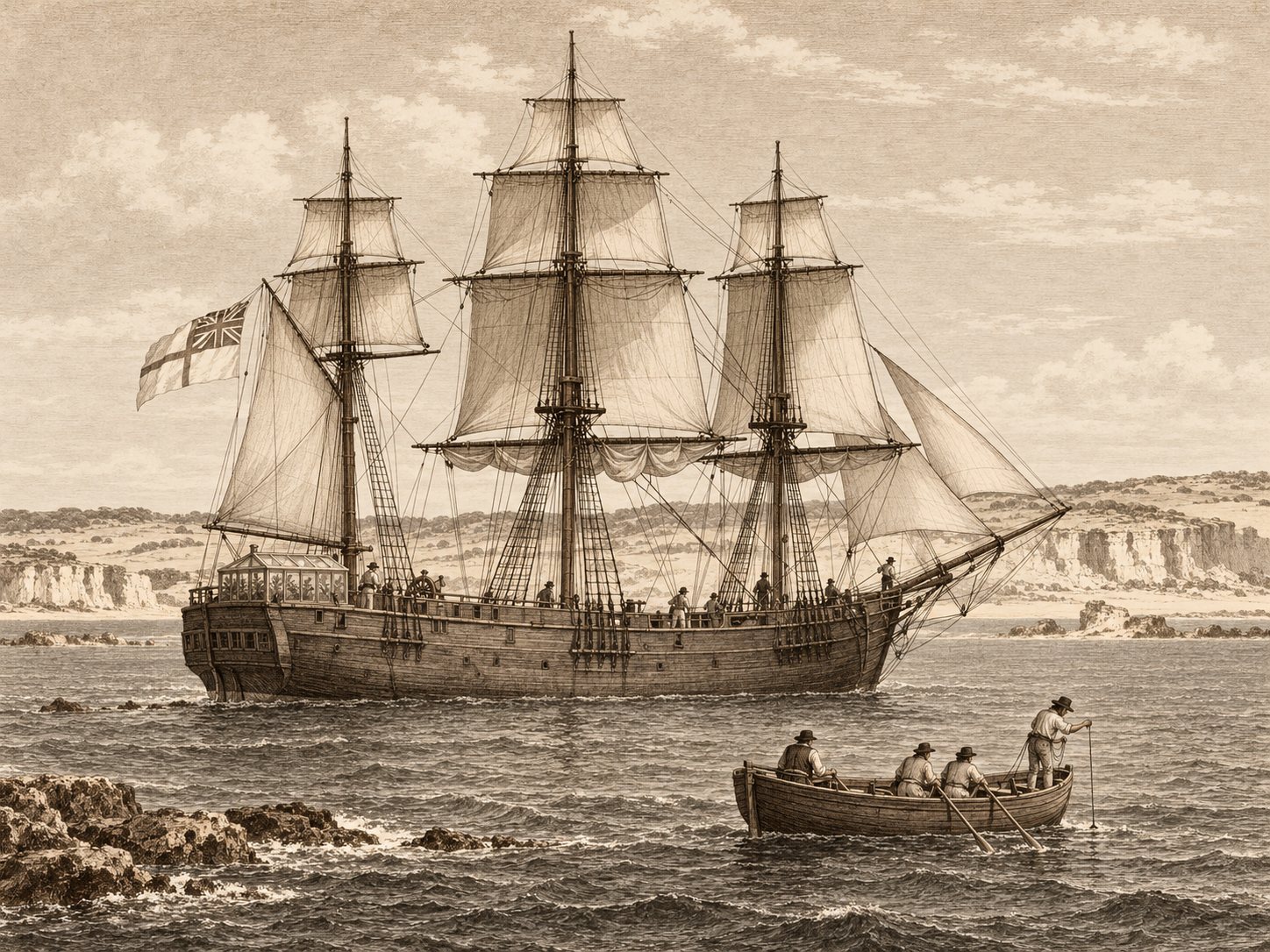
L'Investigator, sloop de découverte (1795-1872)

Reconstitution d'après les sources connues ; aucune représentation d'époque de ce navire n'est conservée.

L'Investigator est construit à Monkwearmouth, près de Sunderland, sous le nom de Fram, un charbonnier lancé en 1795 qui navigue le long de la côte nord-est de l'Angleterre. La Royal Navy l'achète en 1798, le fait radouber par le chantier Pitcher, puis l'arme de 22 caronades comme navire d'escorte sous le nom de HMS Xenophon. Commandé par George Sayer en mer du Nord, il ramène en 1799 de Hambourg le rebelle irlandais James Napper Tandy et ses compagnons.

À l'instigation de Joseph Banks, l'Amirauté décide d'envoyer une expédition lever les côtes de l'Australie et en étudier la faune et la flore, avec le botaniste Robert Brown, le peintre botanique Ferdinand Bauer et le paysagiste William Westall. Le Xenophon est retenu : son faible tirant d'eau et ses vastes cales d'ancien navire marchand conviennent à un long voyage, et son mauvais état permet de s'en passer dans la guerre contre la France. Transformé à Sheerness de novembre 1800 à mars 1801 — cabines pour les savants, place sur le pont pour les plantes, armement réduit — il devient l'Investigator. Flinders, nommé le 19 janvier 1801, écrit : « L'Investigator était un navire construit dans le Nord, de trois cent trente-quatre tonneaux, et dont la forme se rapprochait beaucoup de celle que recommandait le capitaine Cook comme la mieux adaptée aux voyages de découverte. »

Parti de Spithead le 18 juillet 1801, il touche le cap de Bonne-Espérance et aperçoit le cap Leeuwin le 6 décembre 1801. Après un mois à King George Sound, il lève la Grande Baie australienne jusqu'au golfe Spencer. Le 21 février 1802, un canot chavire avec le maître John Thistle, l'aspirant William Taylor et six matelots : Flinders nomme le lieu Cape Catastrophe. Il lève ensuite Port Lincoln, l'île Kangourou, la péninsule de Yorke et le golfe Saint-Vincent, et rencontre le 8 avril, à Encounter Bay, le Géographe de Nicolas Baudin. Par le détroit de Bass, King Island et Port Phillip, il gagne Port Jackson le 9 mai 1802.

Le 22 juillet 1802, il repart vers le nord avec le Lady Nelson et Bungaree, longe la Grande Barrière, franchit le détroit de Torres et lève le golfe de Carpentarie. Là, l'examen de la coque révèle des bois pourris et de graves voies d'eau : le charpentier lui donne six mois. Flinders cherche en vain un navire de remplacement à Timor puis, l'équipage miné par la dysenterie et le scorbut, rentre par l'ouest et le sud, achevant le tour du continent. Il doit abandonner en route deux ancres, retrouvées en 1973 à Middle Island, dans l'archipel de la Recherche, et aujourd'hui exposées au South Australian Maritime Museum et au National Museum of Australia.

De retour à Port Jackson le 9 juin 1803, le navire est jugé par une commission « ne valant pas d'être réparé dans aucun pays ». Flinders le laisse comme ponton et embarque sur le Porpoise. Réparé malgré tout en 1804, regréé en brick, l'Investigator rentre en Angleterre en 1805 sous le commandement de William Kent, avec Robert Brown, Ferdinand Bauer et leurs collections. Déclaré inapte à Plymouth, il devient ponton-prison, puis est vendu en décembre 1810 au marchand George Baily pour 1 253 livres.

Redevenu le Xenophon, il navigue encore quarante ans pour le commerce, notamment entre Londres, Bristol et Québec. En 1853, il entre à Geelong avec une cargaison de bois, puis est vendu à Melbourne et transformé en ponton. Son registre est clos en 1872 avec la mention « démoli ». Environ 260 noms donnés par Flinders datent de son voyage.

NomsFram (1795), HMS Xenophon (1798), HMS Investigator (1801), Xenophon (1810)
ConstructeurInconnu, à Monkwearmouth (Sunderland)
Lancement1795, comme charbonnier
Acquisition1798, par la Royal Navy
TransformationSheerness, novembre 1800 - mars 1801
SortVendu en 1810 ; navire marchand, puis ponton à Melbourne ; démoli vers 1872
Caractéristiques
TypeSloop de découverte (ancien charbonnier)
Tonnage333 68/94 tonneaux (jauge BOM) ; 334 selon Flinders
Longueur30,6 m hors tout (100 ft 4 in) ; 23,7 m à la quille (77 ft 8 in)
Largeur8,7 m (28 ft 5 in)
Tirant d'eau4,6 m (15 ft)
Creux3,4 m (11 ft)
GréementTrois-mâts ; brick après 1804
PropulsionVoiles
Équipage80 hommes
Armement
  • Comme sloop : 18 caronades de 32 livres et 2 de 18
  • Pour le voyage : 6 caronades de 12 livres, 2 de 18, 2 canons longs de 6 et 2 pierriers d'une demi-livre

Sources : Wikipédia ; Matthew Flinders, A Voyage to Terra Australis (1814).

The Investigator, sloop of discovery (1795-1872)

Reconstruction based on known sources; no contemporary depiction of this vessel survives.

The Investigator was built at Monkwearmouth, near Sunderland, as the Fram, a collier launched in 1795 that worked off the north-east coast of England. The Royal Navy bought her in 1798, had her refitted by Pitcher's yard, and armed her with 22 carronades as an escort vessel under the name HMS Xenophon. Under George Sayer in the North Sea she brought the Irish rebel James Napper Tandy and his associates from Hamburg in 1799.

At the urging of Joseph Banks, the Admiralty decided to send an expedition to chart the coasts of Australia and study its plants and animals, with the botanist Robert Brown, the botanical artist Ferdinand Bauer and the landscape artist William Westall. The Xenophon was chosen: her small draught and ample hold as a former merchantman suited a long voyage, and her poor condition meant she could be spared from the war with France. Fitted out at Sheerness from November 1800 to March 1801 — cabins for the scientists, deck space for plants, reduced armament — she became the Investigator. Flinders, appointed on 19 January 1801, wrote: “The Investigator was a north-country-built ship, of three-hundred and thirty-four tons; and, in form, nearly resembled the description of a vessel recommended by Captain Cook as best calculated for voyages of discovery.”

Sailing from Spithead on 18 July 1801, she called at the Cape of Good Hope and sighted Cape Leeuwin on 6 December 1801. After a month in King George Sound she ran a survey of the Great Australian Bight to Spencer Gulf. On 21 February 1802 a boat capsized with the master John Thistle, midshipman William Taylor and six seamen: Flinders named the place Cape Catastrophe. He then surveyed Port Lincoln, Kangaroo Island, Yorke Peninsula and St Vincent Gulf, and on 8 April met Nicolas Baudin's Géographe at Encounter Bay. By Bass Strait, King Island and Port Phillip she reached Port Jackson on 9 May 1802.

On 22 July 1802 she sailed north again with the Lady Nelson and Bungaree, followed the Great Barrier Reef, passed Torres Strait and surveyed the Gulf of Carpentaria. There an examination of the hull revealed rotten timbers and serious leaks: the carpenter gave her six months. Flinders looked in vain for a replacement at Timor and then, with his crew weakened by dysentery and scurvy, returned by the west and south coasts, completing the circumnavigation. On the way he had to abandon two anchors, recovered in 1973 at Middle Island in the Recherche Archipelago and now displayed at the South Australian Maritime Museum and the National Museum of Australia.

Back at Port Jackson on 9 June 1803, the ship was judged by a survey “not worth repairing in any country”. Flinders left her as a hulk and took passage in the Porpoise. Repaired after all in 1804 and re-rigged as a brig, the Investigator returned to England in 1805 under William Kent, with Robert Brown, Ferdinand Bauer and their collections. Declared unseaworthy at Plymouth, she became a prison hulk and was sold in December 1810 to the merchant George Baily for £1,253.

As the Xenophon once more, she traded for another forty years, notably between London, Bristol and Quebec. In 1853 she put into Geelong with a cargo of timber, was sold at Melbourne and converted into a hulk. Her register was closed in 1872 with the note “broken up”. Some 260 of the names given by Flinders date from her voyage.

NamesFram (1795), HMS Xenophon (1798), HMS Investigator (1801), Xenophon (1810)
BuilderUnknown, at Monkwearmouth (Sunderland)
Launched1795, as a collier
Acquired1798, by the Royal Navy
ConversionSheerness, November 1800 - March 1801
FateSold 1810; merchantman, then hulk at Melbourne; broken up about 1872
Characteristics
TypeSloop of discovery (former collier)
Tons burthen333 68/94 (bm); 334 according to Flinders
Length30.6 m overall (100 ft 4 in); 23.7 m keel (77 ft 8 in)
Beam8.7 m (28 ft 5 in)
Draught4.6 m (15 ft)
Depth of hold3.4 m (11 ft)
Sail planThree-masted ship; brig after 1804
PropulsionSail
Complement80
Armament
  • As sloop: 18 × 32-pounder carronades + 2 × 18-pounder carronades
  • As discovery vessel: 6 × 12-pounder carronades, 2 × 18-pounder carronades, 2 × long 6-pounders and 2 × ½-pounder swivel guns

Sources: Wikipedia; Matthew Flinders, A Voyage to Terra Australis (1814).