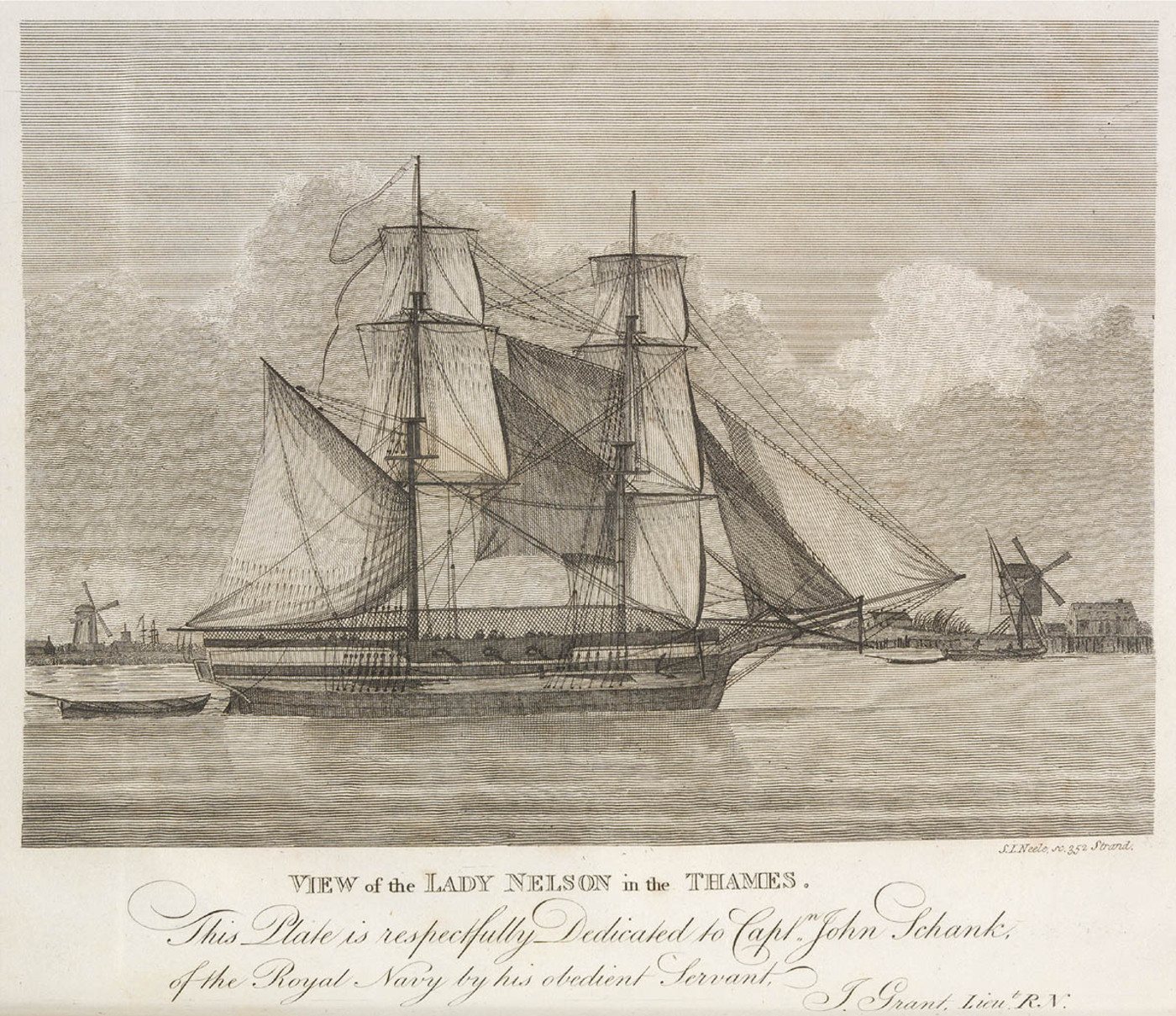
Le Lady Nelson, brick de levé à quilles mobiles (1798-1825)

« View of the Lady Nelson in the Thames », gravure de Samuel John Neele pour le récit de James Grant (1803), domaine public.

À la fin des années 1790, la Nouvelle-Galles du Sud n'a plus de navire capable d'explorer : le Supply est condamné, le Reliance à bout de forces, et le Francis ne jauge que 44 tonneaux. En 1799, le Transport Board fait construire sur la Tamise un cotre de 60 tonneaux, le Lady Nelson, sur le modèle du Trial du capitaine John Schanck : il porte trois quilles mobiles, des dérives que l'équipage peut lever ou abaisser séparément pour naviguer en eaux peu profondes.

Philip Gidley King, alors en Angleterre, obtient qu'il soit affecté à la colonie, pour un coût de 890 livres. L'ayant inspecté le 8 octobre 1799 à Deptford, il suggère de le gréer en brick plutôt qu'en cotre, gréement que peu de marins savent manœuvrer ; Schanck approuve. Construit par John Dudman à Deadman's Dock, à Deptford, le navire cale 12 pieds quilles baissées, et 6 seulement quilles relevées. Son premier commandant est le lieutenant James Grant.

Parti de Portsmouth le 18 mars 1800 en convoi avec des navires de la Compagnie des Indes et le Porpoise, il peine à suivre, perd et remplace plusieurs fois ses quilles, relâche longuement au Cap, puis devient en décembre 1800 le premier navire à atteindre la côte est de l'Australie par le détroit de Bass ; il arrive à Sydney le 16 décembre 1800. Son second commandant, John Murray, reconnaît l'entrée de Port Phillip en janvier 1802, y pénètre le 14 février et en prend possession le 8 mars.

En mai 1802, King reçoit l'ordre d'en faire la conserve de l'Investigator. Les deux navires quittent Port Jackson le 22 juillet 1802 ; le Lady Nelson peut lever des côtes trop peu profondes pour l'Investigator, et Flinders y embarque parfois. Il est présent à la découverte de Port Curtis et de Port Bowen. Mais il s'échoue plusieurs fois, perd à Broad Sound une partie de ses quilles, puis une ancre près des îles Percy. Le 17 octobre, Murray note que l'Investigator gagne sans peine quatre milles au vent sur lui en six heures ; le même jour, Flinders le renvoie à Port Jackson.

Le brick participe ensuite à la fondation des établissements de la Derwent, de Port Dalrymple, de Newcastle et de Port Macquarie, puis, en 1824, de Fort Dundas, sur l'île Melville. Envoyé chercher des vivres vers Timor, il disparaît en février 1825 : son équipage est massacré près de l'île de Babar. Deux répliques ont été construites, à Mount Gambier (1986) et par la Tasmanian Sail Training Association à Hobart (1988).

NomHM Armed Survey Vessel Lady Nelson
ConstructeurJohn Dudman, Deadman's Dock, Deptford
Lancement1798
Mise en service1799
ExploitantRoyal Navy
SortPerdu en 1825 près de l'île de Babar, équipage massacré
Caractéristiques
TypeNavire de levé armé, à trois quilles mobiles
Tonnage60 tonneaux (jauge BOM)
Longueur16 m (52 ft 6 in)
Largeur5,3 m (17 ft 6 in)
Tirant d'eau3,7 m (12 ft) quilles baissées ; environ 1,8 m quilles relevées
GréementBrick
PropulsionVoiles
Équipage17 hommes
Armement6 canons de bronze (3 et 4 livres)
Avec FlindersJuillet - octobre 1802, conserve de l'Investigator

Sources : Wikipédia ; Matthew Flinders, A Voyage to Terra Australis (1814).

The Lady Nelson, survey brig with sliding keels (1798-1825)

“View of the Lady Nelson in the Thames”, engraving by Samuel John Neele for James Grant's narrative (1803), public domain.

At the end of the 1790s New South Wales had no vessel fit for exploration: the Supply had been condemned, the Reliance was worn out and the Francis measured only 44 tons. In 1799 the Transport Board had a 60-ton cutter, the Lady Nelson, built on the Thames to the design of Captain John Schanck's Trial: she carried three sliding keels, centre-boards the crew could raise or lower individually to work in shallow water.

Philip Gidley King, then in England, had her assigned to the colony, at a cost of £890. Having inspected her at Deptford on 8 October 1799, he suggested rigging her as a brig rather than a cutter, a rig few seamen knew how to handle; Schanck agreed. Built by John Dudman at Deadman's Dock, Deptford, she drew 12 feet with her keels down and only 6 with them raised. Her first commander was Lieutenant James Grant.

Leaving Portsmouth on 18 March 1800 in convoy with East Indiamen and the Porpoise, she struggled to keep up, lost and replaced her keels more than once, waited long at the Cape, and in December 1800 became the first vessel to reach the east coast of Australia through Bass Strait; she arrived at Sydney on 16 December 1800. Her second commander, John Murray, found the entrance of Port Phillip in January 1802, entered it on 14 February and took possession on 8 March.

In May 1802 King was ordered to employ her as tender to the Investigator. The two ships left Port Jackson on 22 July 1802; the Lady Nelson could survey waters too shallow for the Investigator, and Flinders sometimes went aboard her. She was present at the discovery of Port Curtis and Port Bowen. But she grounded several times, lost parts of her keels in Broad Sound and then an anchor near the Percy Isles. On 17 October Murray noted that the Investigator could easily gain four miles to windward of him in six hours; that same day Flinders sent her back to Port Jackson.

The brig went on to help found the settlements on the Derwent, at Port Dalrymple, Newcastle and Port Macquarie, and in 1824 Fort Dundas on Melville Island. Sent for provisions towards Timor, she was lost in February 1825: her crew was massacred near Babar Island. Two replicas have been built, at Mount Gambier (1986) and by the Tasmanian Sail Training Association in Hobart (1988).

NameHM Armed Survey Vessel Lady Nelson
BuilderJohn Dudman, Deadman's Dock, Deptford
Launched1798
Commissioned1799
OperatorRoyal Navy
FateLost in 1825 near Babar Island, crew massacred
Characteristics
TypeArmed survey vessel with three sliding keels
Tons burthen60 (bm)
Length16 m (52 ft 6 in)
Beam5.3 m (17 ft 6 in)
Draught3.7 m (12 ft) with keels lowered; about 1.8 m with keels raised
Sail planBrig
PropulsionSail
Complement17
Armament6 brass carriage guns (3- and 4-pounders)
With FlindersJuly - October 1802, tender to the Investigator

Sources: Wikipedia; Matthew Flinders, A Voyage to Terra Australis (1814).