Le Porpoise, sloop de la Royal Navy (1799-1803)

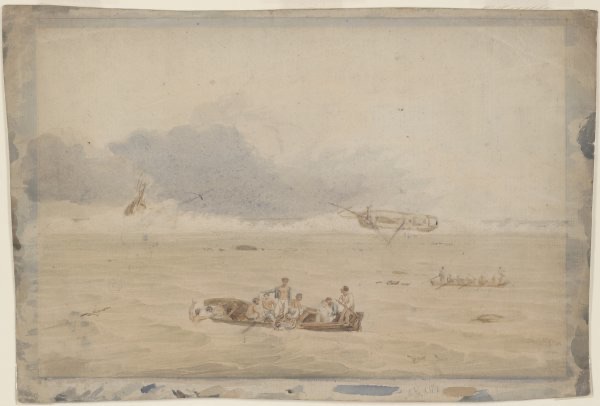
Wreck of the Porpoise, William Westall, 1803 (National Library of Australia), domaine public.

Le HMS Porpoise est un sloop de guerre de 12 canons, construit à Bilbao comme paquebot-poste espagnol sous le nom d'Infanta Amelia. Le 6 août 1799, le HMS Argo le capture au large du Portugal.

Armé en octobre 1799 sous le lieutenant William Scott comme transport pour la Nouvelle-Galles du Sud, il part en 1800 dans le même convoi que le Lady Nelson et arrive à Port Jackson le 7 novembre 1800. Il apporte une collection de plantes européennes choisies par Joseph Banks et fournies par le pépiniériste Hugh Ronalds, pour remplacer celles perdues avec le Guardian ; le jardinier George Suttor les soigne pendant la traversée. Le gouverneur King s'en nomme lui-même capitaine, en laissant le commandement effectif à Scott, qui le conduit à l'île Norfolk et à Tahiti, où il échange des armes contre du porc salé.

En juin 1803, avec le Lady Nelson, il tente de gagner la Derwent pour fonder le premier établissement européen en Terre de Van Diemen, mais le mauvais temps oblige les deux navires à rentrer à Sydney.

Le 10 août 1803, il quitte Sydney sous le commandement du lieutenant Robert Fowler, avec Flinders comme passager, une partie de l'équipage de l'Investigator, ses cartes et ses journaux, en compagnie du Cato du capitaine John Park et du navire de la Compagnie des Indes Bridgewater du capitaine Palmer. Le 17 août, le Porpoise et le Cato touchent un récif de corail et se brisent ; le Bridgewater poursuit sa route et annonce plus tard la perte des deux navires sans survivants. Les naufragés gagnent un banc de sable ; plusieurs œuvres de William Westall, à bord, sont endommagées.

Le 26 août 1803, Flinders et Park partent avec douze hommes dans le plus grand canot, baptisé Hope, et parcourent quelque 800 milles jusqu'à Port Jackson, atteint le 8 septembre. Le Rolla, la Cumberland et le Francis vont recueillir les survivants ; trois hommes seulement ont péri. Fowler, Samuel Flinders et John Franklin gagnent la Chine sur le Rolla, puis prennent part sur l'Earl Camden à la bataille de Pulo Aura.

Les épaves du Cato et du Porpoise ont été retrouvées en 1965 par Ben Cropp sur les Wreck Reefs, au large du Queensland ; le site est protégé depuis le 29 avril 1992.
NomsInfanta Amelia (Espagne), puis HMS Porpoise
ConstructionArsenal de Bilbao, vers 1799
Capture6 août 1799, par le HMS Argo, au large du Portugal
Mise en serviceOctobre 1799, lieutenant William Scott
SortNaufragé le 17 août 1803 à Wreck Reef (mer de Corail)
Caractéristiques
TypeSloop de guerre (ancien paquebot-poste)
Tonnage308 tonneaux (jauge BOM)
Longueur28,3 m hors tout (93 ft) ; 22,7 m à la quille (74 ft 4 in)
Largeur8,5 m (27 ft 11 in)
Creux3,7 m (12 ft 3 in)
PropulsionVoiles
Armement10 canons de 6 livres
Avec FlindersAoût 1803, comme passager
ÉpaveRetrouvée en 1965 par Ben Cropp ; site protégé depuis 1992
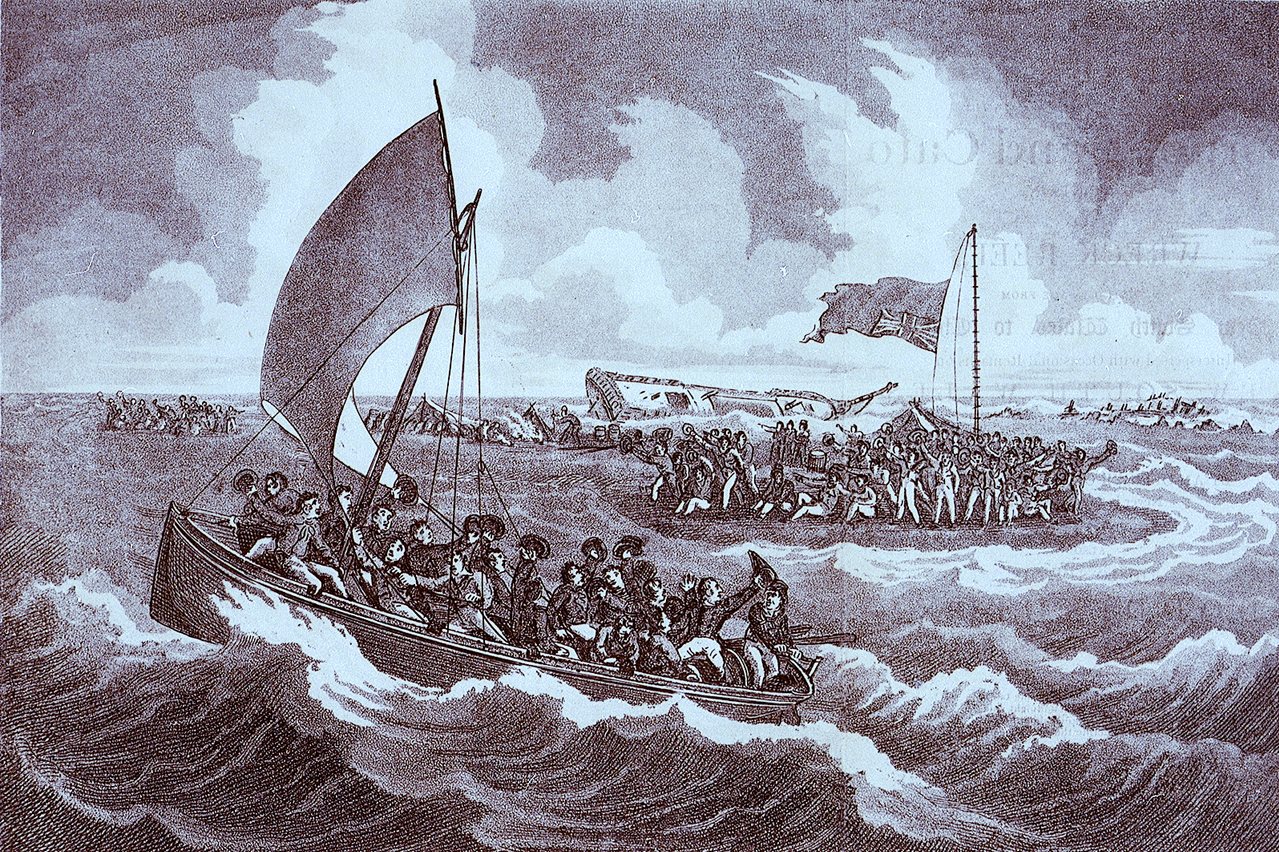
Les équipages du Porpoise et du Cato sur le banc de Wreck Reef, gravure du XIXe siècle (Royal Museums Greenwich), domaine public.

Sources : Wikipédia ; Matthew Flinders, A Voyage to Terra Australis (1814).

The Porpoise, Royal Navy sloop (1799-1803)

Wreck of the Porpoise, William Westall, 1803 (National Library of Australia), public domain.

HMS Porpoise was a 12-gun sloop-of-war, built at Bilbao as the Spanish packet ship Infanta Amelia. On 6 August 1799 HMS Argo captured her off the coast of Portugal.

Commissioned in October 1799 under Lieutenant William Scott as a storeship for New South Wales, she sailed in 1800 in the same convoy as the Lady Nelson and arrived at Port Jackson on 7 November 1800. She carried a selection of European plants arranged by Joseph Banks and supplied by the nurseryman Hugh Ronalds, to replace those lost in the Guardian; the gardener George Suttor tended them on the voyage. Governor King appointed himself her captain, leaving actual command to Scott, who took her to Norfolk Island and to Tahiti, trading arms for salt pork.

In June 1803, with the Lady Nelson, she tried to reach the Derwent to found the first European settlement in Van Diemen's Land, but bad weather forced both vessels back to Sydney.

On 10 August 1803 she left Sydney under Lieutenant Robert Fowler, carrying Flinders as a passenger with part of the Investigator's company, his charts and his journals, in company with the Cato under Captain John Park and the East Indiaman Bridgewater under Captain Palmer. On 17 August the Porpoise and the Cato struck a coral reef and broke up; the Bridgewater sailed on and later reported both ships lost with no survivors. The castaways reached a sandbank; several of William Westall's works, on board, were damaged.

On 26 August 1803 Flinders and Park set off with twelve men in the largest cutter, named Hope, and covered some 800 miles to Port Jackson, reached on 8 September. The Rolla, the Cumberland and the Francis went to take off the survivors; only three men had died. Fowler, Samuel Flinders and John Franklin went on to China in the Rolla, then fought in the Earl Camden at the Battle of Pulo Aura.

The wrecks of the Cato and the Porpoise were found in 1965 by Ben Cropp on the Wreck Reefs off Queensland; the site has been protected since 29 April 1992.

NamesInfanta Amelia (Spain), then HMS Porpoise
BuiltDockyard, Bilbao, about 1799
Captured6 August 1799, by HMS Argo, off Portugal
CommissionedOctober 1799, Lieutenant William Scott
FateWrecked 17 August 1803 on Wreck Reef (Coral Sea)
Characteristics
TypeSloop-of-war (former packet ship)
Tons burthen308 (bm)
Length28.3 m overall (93 ft); 22.7 m keel (74 ft 4 in)
Beam8.5 m (27 ft 11 in)
Depth of hold3.7 m (12 ft 3 in)
PropulsionSail
Armament10 × 6-pounder guns
With FlindersAugust 1803, as a passenger
WreckFound in 1965 by Ben Cropp; protected site since 1992
The crews of the Porpoise and the Cato on the Wreck Reef bank, 19th-century print (Royal Museums Greenwich), public domain.

Sources: Wikipedia; Matthew Flinders, A Voyage to Terra Australis (1814).